
Getting Around Tenerife: Car, Bus or Taxi?
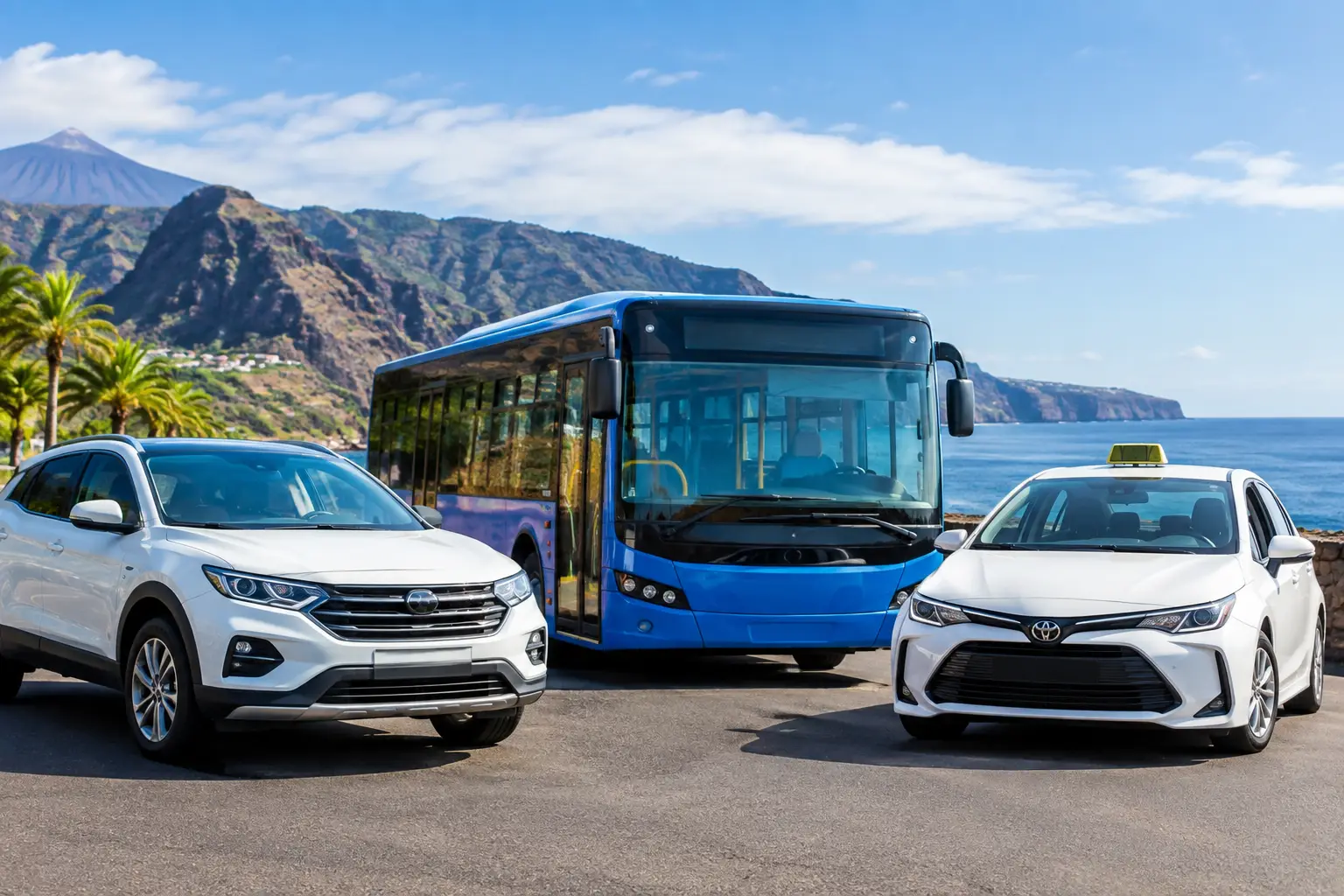
Landing at Tenerife South Airport and assuming every resort is a short taxi ride away is an easy mistake. The island looks compact on a map, but getting around Tenerife can mean anything from a simple beachfront walk in Los Cristianos to a winding mountain drive through Teide National Park. Your best option depends far more on where you stay and what you plan to do than on the length of your holiday.
For most visitors, the choice is straightforward: hire a car if you want to see several parts of the island independently; use buses and taxis if you are staying mainly in one resort; or combine local transport with organised day trips if you would rather not drive. Here is how to choose without paying for transport you will not use.
Getting around Tenerife: choose by holiday style
| Your plans | Most practical option | Why | |—|—|—| | Beach holiday based in Costa Adeje, Playa de las Américas or Los Cristianos | Walking, taxis and occasional bus | Resorts are close together and many essentials are nearby | | Exploring Teide, Masca, Anaga and quieter villages | Hire car | Gives you freedom on routes poorly served by direct public transport | | Staying in Puerto de la Cruz or Santa Cruz without driving | Bus, tram and taxis | The north and capital area have useful public transport connections | | Families wanting a low-stress day out | Pre-booked transfer and selected excursions | Avoids car seats, unfamiliar roads and parking decisions | | Two-centre holiday in north and south Tenerife | Hire car or private transfer between hotels | Luggage makes multiple bus changes less appealing |
A car is not automatically the best value. If you are in a south-coast hotel for a week, plan to spend most days by the pool or beach, and only want one or two outings, paying for car hire and hotel parking may cost more than a couple of taxis and an excursion.
First, know which airport you are using
Most UK holiday flights arrive at Tenerife South Airport, also known as TFS or Reina Sofía. It is the convenient airport for Costa Adeje, Playa de las Américas, Los Cristianos, Golf del Sur and the south-west coast.
Tenerife North Airport, TFN, is nearer Santa Cruz de Tenerife, La Laguna and Puerto de la Cruz. It is used more often for inter-island and domestic Spanish flights, although schedules can change. Check the airport code on your booking before arranging a transfer, particularly if you have booked flights separately.
Airport transfers: the decision to make before you fly
For a package-style stay in a single south-coast resort, a shared coach transfer can be good value, but it may involve several hotel stops. A private transfer usually costs more but takes the uncertainty out of an evening arrival, travelling with young children or carrying a lot of luggage.
Taxis are available at both airports, but the final fare depends on the destination, time and traffic. Use the official rank, ask the driver to confirm the likely fare before leaving, and make sure the meter is used. Pre-booking can make sense when you want a fixed arrangement, but compare the vehicle size and luggage allowance rather than choosing on headline price alone.
Car hire is often most convenient from the airport, especially for a touring holiday. Check whether your accommodation has parking before committing. Central Santa Cruz, older parts of Puerto de la Cruz and some busy resort areas can make overnight parking less simple than it appears in a car-hire search.
Hiring a car in Tenerife
A hire car is the strongest choice for travellers who want to set their own pace. It makes it realistic to visit Teide National Park early in the day, stop in Garachico or Icod de los Vinos on the way north, and leave crowded viewpoints behind when you choose. It is also useful if you are staying in a villa, rural property or a resort away from the main promenade.
The trade-off is the driving itself. Tenerife’s main TF-1 motorway makes travel along much of the south and east coast relatively simple, but the island’s interior is steep. Roads around Masca, the Anaga Rural Park and parts of the Teide route have sharp bends, changing weather and limited places to pull over. They are memorable journeys, not routes to tackle casually after a long flight.
Choose a car size for the roads, not only for luggage. A compact car is easier to park and more comfortable on narrow streets, while a larger vehicle may suit a family carrying pushchairs and beach gear. Automatic cars are often in lower supply than manuals, so reserve early if you need one.
Before booking, compare the full terms: excess, deposit, fuel policy, additional-driver charges, tyre and windscreen cover, and whether you need to return the vehicle with a particular fuel level. Photograph the car at collection and return. These small checks are more useful than selecting the lowest daily rate and sorting out the details at the desk.
Where a car is less useful
If your hotel is in Costa Adeje, Playa de las Américas or Los Cristianos and your plans revolve around the beach, restaurants and boat trips from the local marina, you may barely use a car. The promenade links much of this coastline, and taxis work well for short hops between resorts.
A car is also less attractive if you intend to enjoy drinks with dinner every evening or feel uneasy driving on mountain roads. In that case, book one or two excursions for the places you most want to see. You will still experience Teide or the north coast without turning every day into a driving plan.
Buses and trams: the sensible alternative
Tenerife’s public buses are operated by TITSA and are known locally as guaguas. They connect the main resorts, airports, Santa Cruz, Puerto de la Cruz and many inland towns. They are a practical budget option when your journey follows a main route, and a useful back-up even if you hire a car for only part of your stay.
Buses are less convenient for multi-stop sightseeing. A journey that is simple by car can involve a change in Santa Cruz or another transport hub, and services to remote areas are naturally less frequent. Check the current timetable, stop location and last return service on the official operator information before setting off. Do not assume a route that runs frequently in the morning will be equally useful after dinner.
In the capital area, the tram is particularly helpful. It links Santa Cruz with La Laguna and avoids the need to navigate city traffic or find parking. For travellers staying in Puerto de la Cruz, buses are generally more relevant than the tram, while south-coast visitors will rely most on buses and taxis.
Transport cards and fares can change, so look at current ticket options shortly before travel. If several of you are making only a handful of journeys, individual fares may be simpler than buying a card designed for frequent use.
Taxis work well for short, targeted journeys
Taxis are a good middle ground for holidaymakers who do not want a car but do not want to organise every outing around a timetable. They are particularly useful between nearby south-coast resorts, for an evening in a restaurant outside walking distance, or for reaching a departure point for a boat trip.
Use licensed taxis and agree practical details before you set off, especially for a return from a quieter location. For longer day trips, it is usually worth comparing the likely taxi cost with car hire or a guided excursion. A taxi gives you flexibility, but waiting time and a return journey can make it poor value for a full day in the mountains.
Plan day trips around geography, not wish lists
Tenerife rewards grouping places by area. Teide National Park and the west-side villages can fit together, but adding Santa Cruz and Anaga on the same day creates more time in the car than time at each place. Likewise, Puerto de la Cruz, La Orotava, Garachico and Icod de los Vinos are better treated as a north-and-west day than as a quick detour from Costa Adeje.
For a south-coast base, allow a full day for Teide and the west, and another for the north if it matters to you. Weather varies with altitude and from coast to coast, so bring an extra layer for Teide even when your resort is hot. If a mountain route is affected by poor weather or restrictions, follow official local advice rather than pressing on because it is in the itinerary.
A simple transport plan that usually works
Book your airport transfer or airport car collection before departure. Then decide whether your itinerary genuinely needs a car every day. Many travellers get the best balance by hiring for two or three days, using it for Teide and a north-coast route, then returning it and enjoying the resort on foot.
Trav can help you compare a full-week car hire against individual airport transfers, taxi journeys and excursions based on your hotel and plans. Start with where you are staying, then build transport around the days you actually want to be out exploring – it is the simplest way to keep Tenerife feeling like a holiday rather than a logistics exercise.